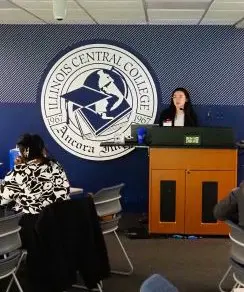
As a learning sciences and educational technology researcher, I spend a lot of my time thinking about how emerging technologies, including AI, support and reshape the way people learn, and how we might design learning environments that make the most of that. Those questions feel especially urgent in community colleges, which sit at the intersection of learning, workforce development, and community needs—and where AI is already changing what students need to learn, what employers expect, and how the colleges themselves operate, whether or not anyone plans for it. So when I was invited to give a keynote at OCCRL’s 2026 Illinois Community College Leadership Institute on leadership in the age of AI (see nearby photo), I was excited to think through these questions with the leaders navigating them every day.
Much of the conversation about AI in higher education today is about how institutions should respond to specific technologies: which tools to adopt, where to draw boundaries, what policies to put in place. Those questions matter. But if that's all we ask, we end up constantly chasing the technology, adjusting our practices every time something new comes along. In my talk I wanted to offer a different first question. Rather than asking only what AI can do, we can begin with what we want future learning and work to look like, and then ask what role AI should play in getting us there. This is the shift I’d call thinking like designers: we start from our values and vision, not from the tool in front of us. Adapting to AI, in this view, is a matter of system redesign, not tool adoption.
So what does thinking like a designer mean in practice? It starts with looking closely at how the landscape is changing and what those changes ask of people. AI is becoming more accessible, more conversational, and more embedded in everyday work and learning. How is that changing work? What new capacities will people need, and what kinds of learning help build them? What should remain distinctly human? With those questions in view, we can see more clearly where AI helps, where it gets in the way, and what needs to be redesigned around it.
One place to begin is the future of work. Public conversation tends to fixate on which jobs AI will replace, but that framing may be too narrow. AI is also changing the tasks, workflows, and decisions inside jobs that aren’t going anywhere. And as work changes, so do the competencies people need. Technical skills like AI and data literacy matter, but so do communication, adaptability, collaboration across disciplines, ethical reasoning, and the ability to make sense of large amounts of information. For educators, that means rethinking how programs, credentials, and learning pathways prepare people for work that will keep evolving.
The same principle applies to learning. When a student can ask AI to summarize a reading, generate ideas, draft a paragraph, or give feedback in seconds, neither banning AI nor bolting it onto existing assignments gets us very far. The harder and more useful work is to reconsider what is worth teaching and what students should keep practicing for themselves. In an AI-rich environment, asking good questions, evaluating information, connecting ideas, explaining one's reasoning, and making informed judgments become more important, not less. These are the capacities that should remain distinctly human—not because AI can’t imitate them, but because they are how people stay in charge of their own learning.
That also means resisting the assumption that AI should always make learning faster or easier. Meaningful learning often requires effort, uncertainty, judgment, and sometimes struggle. In my own research and teaching, I’ve been exploring this by embedding AI within curriculum and assignment redesign, and by building AI tools that aim to support deeper knowledge construction and reflective thinking rather than bypass them. The goal is for students to practice thinking and learning with AI while remaining responsible for interpreting information, making connections, and making decisions. Over time, that practice builds a more deliberate relationship with AI: recognizing where human and machine capacities differ and complement each other, and using AI to think more deeply, notice new possibilities, and judge more critically.
For community college leaders, this design-oriented perspective shifts attention from individual AI tools to the larger systems those tools operate within. AI literacy and fluency are part of it. So are redesigning learning and workforce pathways, protecting equity and trust, and building partnerships that connect education to the needs of employers and communities.
The question for leaders, then, is what kind of future we want to design with AI. The specific technologies will keep changing. Leadership in this moment means shaping learning and work so that technology expands human capacity rather than narrows it—a future in which people and AI work together to widen what is possible for our communities.