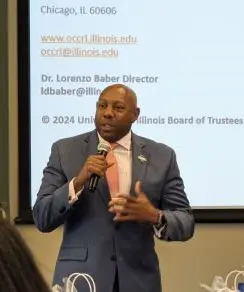
Having served as executive director of the Illinois Community College Trustees Association (ICCTA) for the past seven years, I have witnessed firsthand the importance of strong leadership in our colleges. As a four-time presenter at OCCRL’s Illinois Community College Leadership Institute (ICCLI), I have come to deeply value the organization’s guidance in equipping future community college presidents and senior administrators with the vision, skills, and confidence to lead transformative institutions.
My work involves collaborating with both trustees and presidents across the 45 community colleges in Illinois, each of which plays a vital role in its community. Every college is unique and intentional in meeting the specific needs of the students, employers, and communities it serves.
The theme of the 2026 ICCLI gave presenters and participants an opportunity to address the challenges community colleges will face with the well-publicized “enrollment cliff” coming for higher education. Illinois is predicted to be one of seven states with the greatest declines in high school graduates through 2041. Yet the ability of our community colleges to adapt to changing landscapes has also been well documented. Therefore, while it may be news to some, the various approaches to addressing the challenges of the enrollment cliff lends itself to a proactive response.
In the spring of 2026, the Illinois Community College Board (ICCB), in partnership with ICCTA and the Illinois Council of Community College Presidents, released a study showing how community colleges in Illinois are a powerful driver of the state’s economy, generating $27.2 billion in total economic impact and supporting 324,273 jobs statewide. The report, “The Economic Value of the Community Colleges of Illinois,” reflects fiscal year 2023–24 data and underscores the critical role of community colleges, including workforce development, business growth, and statewide economic mobility.
The higher education strategic plan in Illinois, “A Thriving Illinois,” prioritizes increasing bachelor’s degree attainment to drive living-wage earnings and economic security. With growing workforce demands in critical industries such as healthcare, technology, and education, Community College Baccalaureate (CCB) degrees align education with state priorities and student demand. CCB degrees equip students with the advanced skills required for in-demand roles, which will empower local communities and strengthen the state’s workforce needs.
The CCB proposal, which has been negotiated with the state’s public universities and is subject to the scrutiny of the Illinois Board of Higher Education and ICCB, is poised for passage in the Illinois General Assembly. The proposal would allow community colleges to offer bachelor's degrees to address workforce demands in limited occupations. While this concept has been discussed among policymakers for years, the new workforce-focused approach is exactly what is needed to address the impending enrollment cliff.
The reality is that we are not going to have more high school graduates attending community colleges. However, there are many working-class individuals who would take advantage of the opportunity to gain the knowledge they need to enhance their careers, continue working in their communities, and raise their families. Advancing CCBs will be transformative for communities and will continue to enhance the economic impact our community colleges have on the state’s economy.
So, you may be asking yourself, how can I contribute to this statewide initiative that would enable Illinois to become the 25th state to grant community colleges the authority to offer bachelor’s degrees? Simply contact your state representative and state senator and ask them to support legislation that would give place-bound working men and women the opportunity to advance their careers and contribute to the economic growth of Illinois. Ask them to give students who might not otherwise seek higher education the opportunity to realize their dreams!