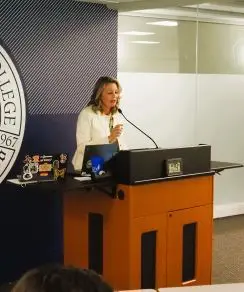
As a community college student affairs practitioner turned graduate program advisor, I always appreciate the opportunity to interact with people in the field that work directly with community college students. Since I have continued to teach about and conduct research on community colleges, I enthusiastically accepted the invitation to attend OCCRL’s 2026 Illinois Community College Leadership Institute to present on shifting state demographics.
It is well established that an “enrollment cliff” is coming for higher education. Illinois is predicted to be one of seven states with the greatest declines in high school graduates through 2041. At the same time, only 61% of students from the nation’s class of 2023 entered higher education (Lane et al., 2024). Even with the predicted cliff, it is clear that much work needs to be done to equitably serve this population. Instead of reacting to this news with gloom and doom, perhaps aspiring community college leaders can focus on the opportunities presented by this reality to stay true to the mission of access and opportunity.
Strohl et al. (2024) have identified three pathways into promising jobs of the future, and while over half are on a bachelor’s degree pathway, opportunities exist within middle-skills pathways and even a high school pathway inclusive of occupational training. This reinforces the importance of career and technical education and the value of community colleges to local economic development. As public sentiment continues to scrutinize rising college costs, the student share at two-year institutions is approximately 20%, in contrast to nearly 50% at their four-year counterparts (State Higher Education Executive Officers Association, 2026). This adds to the good news for community colleges as it demonstrates that they are particularly worthy of investment given their affordability and relevance to workforce needs.
Addressing these future workforce needs will require more than just fixating on competing for the attention of a shrinking number of high school graduates. While community colleges can and should work with high school partners to expand college and career readiness, particularly for underserved populations, they are also well positioned to prioritize adult populations.
As proposed federal changes to higher education grants threaten the ability of community colleges to support historically marginalized populations (Vance, 2026), there must be a recognition of and plan for resolving local barriers across age groups that prevent educational engagement and workforce participation. In practice, a good starting point can be to think about the concept of “servingness” developed specifically for Hispanic-serving institutions (HSIs) by Garcia (2019) as “a multidimensional and conceptual way to understand what it means to move from simply enrolling Latinx students to actually serving them (p. 1).” Even as the number of high school graduates decline, those that are graduating will become increasingly racially and ethnically diverse with more students identifying as Latinx or multiracial, making this particularly relevant (Lane et al., 2024).
The state of Illinois is currently engaged in setting a new goal for future educational attainment with a working group tasked with submitting a recommendation to Governor Pritzker by the end of this calendar year (Executive Order 2026-03). Leveraging the state’s community colleges that are composed of diverse organizational identities, such as rural and/or minority serving, will be critical to meeting any established goal. Future leaders, who will be confronted with a plethora of challenges such as demographic shifts and rapidly changing workforce needs, can apply the idea of servingness to cultivate institutional identity and create opportunities that guide purposeful actions to advance student success.
References
Garcia, G. A. (2019). Defining “servingness” at Hispanic-serving institutions (HSIs): Practical implications for HSI leaders. American Council on Education.
Lane, P., Falkenstern, C., & Bransberger, P. (2024). Knocking at the college door: Projections of high school graduates. Western Interstate Commission for Higher Education. https://www.wiche.edu/knocking
State Higher Education Executive Officers Association. (2026). State Higher Education Finance: FY2025. https://shef.sheeo.org/report/
Strohl, J., Gulish, A, & Morris, C. (2024). The future of good jobs: Projections through 2031. Georgetown University Center on Education and the Workforce.
Vance, S. (2026, July 15). The government tried to cancel colleges’ grants. Now it’s rewriting the rules for awarding them. The Chronicle of Higher Education.