-
Who We Are -
What We Do -
Current Projects - Artificial Intelligence in Career and Technical Education
- Comprehensive Local Needs Assessment
- ICCB Developmental Education Reform
- Pipeline for the Advancement of the Healthcare Workforce (PATH)
- Portraits of Community College Student-Leaders: Emerging Visions for the Future
- Program Review Illinois
- SUCCESS: Supporting Universities and Colleges Creating Equitable Student Success
- Workforce Empowerment Initiative Culturally Responsive Evaluation Institute
-
Our Products -
Contact Us
SUCCESS: Supporting Universities and Colleges Creating Equitable Student Success
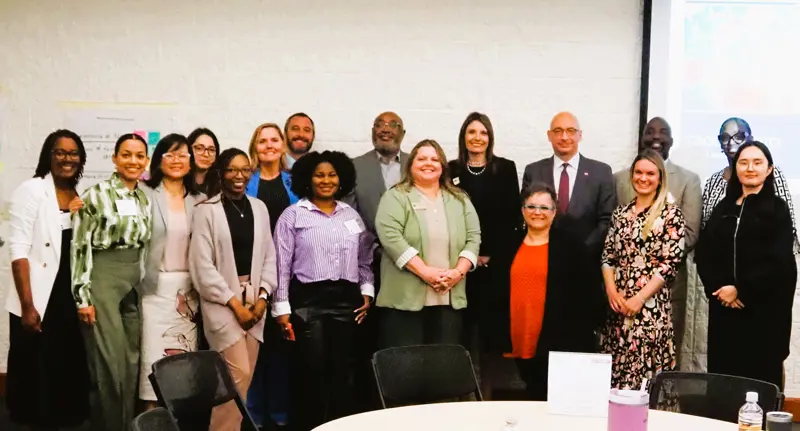
View photos from our 2026 gathering at Lincoln Land Community College in Springfield.
 SUCCESS is an initiative led by the Governor’s Office, the Illinois Board of Higher Education, the Illinois Community College Board, the Office of Community College Research and Leadership, and the Office for Academic Programs, Student Success, and Effectiveness at UIC. The program provides support to colleges and universities as they implement, refine, and advance institutional practices guided by their 2024-25 Equity Plans, which were created by campuses in response to the campus equity plans and A Thriving Illinois.
The SUCCESS program aims to support colleges and universities to improve institutional performance to close equity gaps, with a focus on students who are traditionally underrepresented in postsecondary education, including but not limited to rural students, first-generation students, low-income students, parent students, and racial/ethnic minorities.
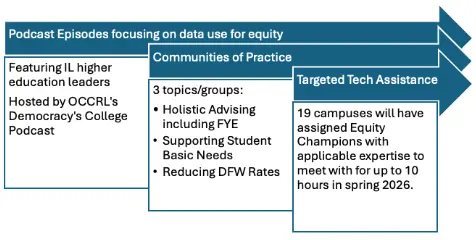
The SUCCESS program offers three interconnected threads of organizational learning to support continuous institutional performance improvements:
1. A limited podcast series on effective data use for equity |
2. Three concurrent communities of practice focused on supporting improvements in holistic advising, meeting students’ basic needs, and reducing D’s, F’s, and withdrawal (DFW) rates |
3. Targeted technical assistance for 19 campuses in the spring of 2026 Meet the Equity Champions:
|
Building Connections that will fuel collaboration all year long.
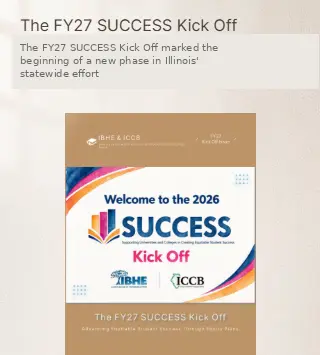
On an October morning in central Illinois, institutional teams from across the state gathered for the FY27 SUCCESS Kick Off. Hosted by the Illinois Board of Higher Education and the Illinois Community College Board, this gathering launched the next chapter in the statewide movement toward equitable student success.
The FY27 SUCCESS Kick Off marked the beginning of a new phase in Illinois’ statewide effort to advance equitable student success. This publication highlights key themes from the event, including progress on educational attainment and affordability, the evolution of the SUCCESS initiative, Communities of Practice, Knowledge Sessions, Targeted Technical Assistance, and the role of data-informed decision-making in improving student outcomes.
Discover how Illinois community colleges, universities, state agencies, and institutional leaders are working together to turn equity plans into meaningful action for students across the state.
SUCCESS Policy Briefs
 Brief #1: Making Transfer Policies ClearStudents may actively search for transfer information, yet still struggle with unfamiliarity and fragmented sources. Policy Brief #1 by Jeongsan Hwang and Karla Velasco highlights how Illinois can strengthen transfer communication through a regularly updated statewide platform, joint advisor training, and earlier transfer guidance. Read the brief. |  Brief #2: Strengthening Transfer Support Beyond the ClassroomTransfer success is a shared institutional responsibility. In Policy Brief #2, Jeongsan Hwang and Mandilyn Graham analyze pre-transfer students’ institutional interactions and psychological, academic, and social adjustment across race, first-generation status, and income—pointing to the value of TRIO, Guided Pathways, structured advising, and peer mentoring. Read the brief. |
 Brief #3: Improving the Community College to Four-Year TransitionStudents shouldn’t have to decode policy jargon to transfer smoothly. Policy Brief #3 by Karla Velasco and Jeongsan Hwang examines the community-college-to-four-year transition, emphasizing student-centered data, faculty-advisor collaboration on articulation agreements, and clear guidance on transfer costs and scholarships. Read the brief. |  Brief #4: Community Mindset, a Tool for SuccessBelonging and psychological adjustment shape how transfer students thrive after arriving at a four-year university. In Policy Brief #4, Mandilyn Graham, Karla Velasco, and Jeongsan Hwang call for 2-year/4-year mental health partnerships, culturally responsive care, diverse representation, and ongoing assessment of post-transfer needs. Read the brief. |
Explore all four Illinois SUCCESS transfer policy briefs together in one interactive flipbook to discover actionable strategies for strengthening transfer communication, advising, and equitable student support.
SUCCESS Podcasts
Illinois SUCCESS: Leading with Hope
With guests Robert Brown and Sara Furr and host OiYan Poon
Flipping the Script to Improve Campus Systems for Student Success
With guests Courtney Luedke and Erick Montenegro and host OiYan Poon
Piloting and Scaling Strategies to Reduce DFWs in Community Colleges
With guest Avis Proctor and host OiYan Poon
Improving Advising and Wraparound Services to More Effectively Support All Students in their Postsecondary Education Journeys
With guest Lonetta Oliver and host OiYan Poon
On-Track Data System at UIC to Inform Work and Improve Student Success
With guest Lindsey Back and host OiYan Poon.
Effective Data Use for Holistic Advising
With guest James Minor and host OiYan Poon
Investing in and Encouraging Academic Leaders to Reduce DFW Rates to Improve Student Success
With guest Jay Gatrell and host OiYan Poon
The Power of Basic-Needs Support through Benefits Navigator and HOUSE Liaisons
With guests Valerie Lynch and Deana Schenk and host Gianina Baker
Different Frameworks for Understanding Institutional Data and Using Data to Attain Student Success
With guest Nick Branson and host OiYan Poon