
During the past few years, I have been doing research on community college baccalaureate, or bachelor’s degree (CCB), programs. I started my Ph.D. program at UCLA’s School of Education & Information Studies in 2021, with an interest in understanding the role and function of community colleges in shaping educational access, success, and equity.
I went in with numerous curiosities and questions regarding how we can create more effective and equitable educational practices, policies, structures, and systems. I didn’t think there would be a singular policy intervention that would address every educational issue we confront.
I wanted to get a better understanding of community colleges—their history, politics, economics, and sociology— and the important contexts that situate how they operate and impact the everyday lives of students and communities.
Along the way, my faculty advisor, Cecilia Rios-Aguilar, shared with me that there were community colleges offering bachelor’s degrees. I remember thinking that it was an interesting policy approach to expanding educational access. There are many benefits of community colleges, including their economic and geographic accessibility to students. In fact, CCB tuition and fees average $5,417 annually compared to $10,022 at public four-year institutions—a difference of nearly $4,600 per year ( Meza, 2025).
But do they actually work?
It has been perplexing piecing all this together as education leaders continue to design more integrated data and information systems, with the goal of capturing the experiences and outcomes of CCB students ( Rios-Aguilar et al., 2025).
In education research, a common question asked is: “Access to What?”
We recognize that expanding educational opportunity involves more than helping students enroll in college. Equally important is ensuring they are positioned to complete their degrees and realize the benefits those credentials can provide. Access to bachelor’s degree programs, successful degree completion, and meaningful labor-market outcomes are all part of a continuum that supports success in school, work, and life.
Access to Bachelor’s Degrees Programs
When higher education leaders talk about expanding college access, they are often referring to increasing opportunities for students to enroll in bachelor’s degree programs. Yet access has historically been uneven, with demographic differences influencing who attends community colleges, who enrolls at traditional four-year institutions, and who does not pursue college at all.
To date, national data and information systems do not make it easy to document the demographics of who enrolls in CCB programs nationwide. A bulk of the research related to CCB have primarily centered on educational access and opportunities to bachelor’s degree programs ( Meza & Love, 2023). We also know:
- In Washington, most CCB students had prior experience at a community college. Among them, 59% had earned an associate degree before matriculating into a bachelor's degree program, and 30% had completed that degree within one year of beginning their bachelor's coursework ( Meza & Vo, 2026a).
In California, 58% of graduates reported that they would not have pursued a bachelor's degree had the bachelor's degree not been offered at their community college ( Vo et al., 2026).
Access to Bachelor’s Degree Completion
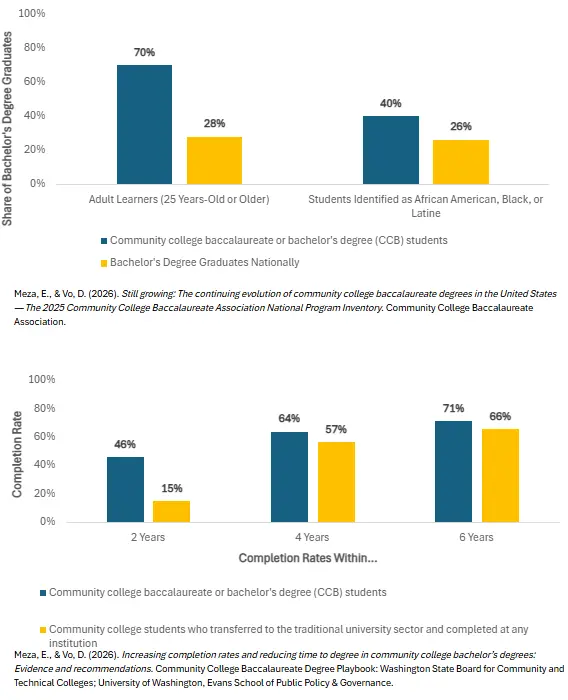 While getting students into college is a major challenge in educational practice and policy, there has also been tremendous focus in ensuring that institutions foster educational environments that allow students from various social contexts and backgrounds to be able complete their programs.
The data points show that students are successful once they begin their upper-division CCB programs. In 2023-24:
70% of recent CCB graduates are adult learners ages 25 and over, compared to 28% of all U.S. bachelor’s degree graduates.
40% of CCB graduates are identified as African American, Black, or Latine compared to 26% nationally ( Meza & Vo, 2026b).
Once enrolled in upper-division coursework, CCB students achieve a two-year completion rate of 46%, compared with 15% among community-college-to-university transfer students. This completion advantage persists across every gender and racial/ethnic group examined. (Meza & Vo, 2026c).
Access to Bachelor’s Degree Benefits in the Labor Market
Getting students into college and supporting them through degree completion are important goals. But another question matters just as much: What benefits do students gain from earning a bachelor's degree? Higher education can produce a range of outcomes, including civic, health, and economic benefits. While earnings are not the only measure of success, they are among the easiest outcomes to quantify.
In Washington, CCB graduates earn $11,400 more in raw annual earnings than non-graduates three years after matriculating into CCB programs. By year 5, CCB graduates are earning $14,000 ( Vo & Meza, 2026).
CCB students benefited from their bachelor’s degree across every gender, race/ethnicity, and age groups examined, as well as across the top 4 most popular programs/fields of study in Washington ( Vo & Meza, 2026)
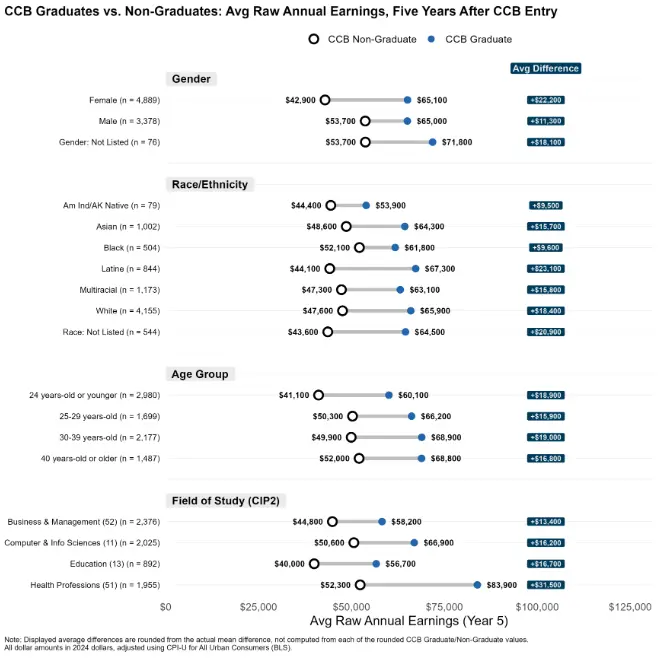
Taken together, these six data points and three figures provide compelling evidence of how CCB programs expand educational opportunity, support degree completion, and contribute to positive labor-market outcomes. While CCB programs are not a silver bullet for every challenge facing higher education, they offer important lessons for policymakers, practitioners, and researchers who are seeking to create more accessible and equitable pathways toward student success.
Thanks to my co-authors Elizabeth Meza, Cecilia Rios-Aguilar, Hai Hoang, Michelle Fowles, and Deb Bragg, as well as Kendrick Hang, Joyce Hammer, Summer Kenesson, Angela Kersenbrock, Colleen Pawlicki, California Community Colleges Bachelor's Degree Committee, Community College Baccalaureate Association, UCLA Civil Rights Project / Proyecto Derechos Civiles, UCLA Latino Politics & Policy Institute, Wheelhouse: The Center for Community College Leadership and Research at UC Davis, and Washington State Board for Community and Technical Colleges.