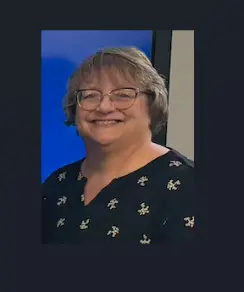
At Lake Land College, program review doesn't stand apart from the college’s broader program improvement work. Dr. Lynn Breer (at left), director of institutional research and reporting, has helped connect the Illinois Community College Board (ICCB) program review process with the college’s Program Improvement and Enhancement (PIE) process. What began as a yearly way to assess the health of career and technical education programs has become an important source of support for program review, providing faculty with access to data, notes, and resources well before the five-year review is due.
Dr. Breer has overseen the ICCB program review process for the past two years. She has also served on the Illinois Program Review Advisory Committee (PRAC) for over two years. In her institutional role, she works with faculty, makes sure program reviews are completed, assembles the reports, and submits them to ICCB. However, her connection to the work began earlier. Through her role in institutional research, reporting, and assessment, Breer had already been involved with the data and reporting processes that support program review. By her own estimation, she has been connected to program review in some capacity for five or six years.
A major part of that connection comes through PIE. Breer explained that PIE was not originally designed as a program review tool. The college created it to assess program health, including enrollment and other indicators, particularly for CTE programs. Over time, the data collected through PIE began to overlap with the information faculty needed for program review. Breer described this overlap as a “happy accident” because the two processes now support one another in practical ways.
Each fall, she works with faculty, program coordinators, and division chairs to review PIE reports, discuss the data, and identify key points. When a program is due for review, those meetings also introduce the program review process. Faculty receive an early reminder that their review is coming up, an explanation of what the review requires, and guidance on where to find the information they will need. Each program also has a shared folder where the college stores PIE reports, meeting notes, labor-market information, and other materials that help faculty complete the review. Rather than starting with a data search, faculty can begin with resources already organized for them.
Breer keeps faculty members at the center of the process; they complete the templates because they know their programs, curriculum, and the changes that have occurred over time. Her role is to make the process easier to manage. Breer reminds faculty when reviews are due, answers questions, helps them work through the template, and reviews materials before they are submitted. She also updates the template each year with resources tied to specific questions. For example, if a question asks about curriculum changes, she includes information about the college’s internal process so faculty do not have to search for it separately. The goal is to streamline the process so faculty can focus on the substance of the review.
Faculty complete program reviews once every five years, which Breer said is a challenge. While she does not argue that they should complete the full review more often, she noted that the five-year cycle can make the process harder. Faculty may underestimate how long the template will take, wait until the last minute, or struggle to remember changes that happened several years earlier. Lake Land College has responded by moving its internal deadline earlier in the semester. Instead of waiting until the end of the spring term, when faculty may no longer be available for follow-up questions and are busy with end-of-term obligations, reviews are now due midterm. This gives Breer and others time to review submissions, ask for clarification, and help faculty strengthen their responses before finalizing the reports.
The annual PIE process also helps address institutional knowledge and memory. During PIE meetings, Breer asks faculty about changes they made to their programs that year, challenges they noticed, and strategies they plan to use moving forward. Those notes are saved and connected back to the program review process. When a comprehensive review is due, faculty can look back across several years of notes rather than trying to reconstruct the program's full history at once. This approach helps reduce the burden of the five-year review and gives faculty a clearer record of what has changed over time.
That record has become especially important as the college experiences faculty turnover. Breer shared that some new program coordinators have been asked to complete reviews soon after stepping into their roles, sometimes without firsthand knowledge of the previous four or five years. In those cases, saved notes, reports, and shared folders help preserve institutional memory for program reviews. A new faculty member may not know every decision made before they arrived, but the process gives them a place to begin and helps prevent the review from depending only on what one person remembers.
Breer’s approach is also shaped by a desire to help faculty see program review as part of improvement rather than just reporting. When PIE first began, she noted some faculty worried that the process was about identifying programs for cuts. Over time, she has reframed the process to help faculty view their programs from another perspective, especially through data they may not be used to reviewing. She sees program review as a natural extension of that work. It gives faculty a chance to look closely at their programs, think about what is working, identify areas that may need attention, and consider what could be done differently.
One example came from the college’s review of course persistence and drop, rail, withdraw (DFW) rates. Through PIE meetings, Breer noticed that several automotive- and diesel-related programs had high DFW rates in electrical courses. Because she participated in multiple program conversations, she saw a pattern that might not have been as visible within a single program. That observation led to a larger discussion with faculty and division leadership about why students were struggling and whether earlier exposure to electrical concepts could help. The college began exploring a dual-credit electrical course to introduce students to the content earlier, with the hope that stronger preparation could improve their later success. Breer described this example as coming directly from PIE rather than from program review. Still, she sees the two processes as connected because both use data and discussion to identify issues and respond to them.
Through these efforts, Lake Land College has intentionally integrated its formal program review requirements with an ongoing, faculty-centered improvement process, using organized data, shared documentation, and structured conversations to make reviews more meaningful and manageable.