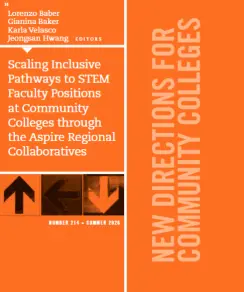
Introducing the New Directions for Community Colleges Summer 2026 Issue
As one of the core pillars of the National Science Foundation-funded INCLUDES Aspire Alliance, OCCRL recently edited a series of articles published in the New Directions for Community Colleges Summer 2026 issue. Through the Aspire initiative, Regional Collaboratives (RCs) across the country have built geographically proximate partnerships among postsecondary institutions to create and strengthen pathways into STEM faculty positions at community colleges. In the later phase of the initiative, OCCRL served as the backbone organization for Aspire, helping develop RCs across the country. When the initiative ended, OCCRL paused to reflect, gathering lessons learned from each RC, as well as insights from our experience supporting and coordinating the work.
The NDCC Summer 2026 issue includes nine chapters. In this blog post, we briefly introduce what each chapter offers to our intellectual community.
The issue opens with an overview of the Aspire Alliance’s RCs, highlighting how this model brings institutions together to address equity gaps in postsecondary STEM education. In the introduction, Lorenzo Baber, Karla Velasco, Jeongsan Hwang, Gianina Baker, Jessica Gregg, Chandra Turpen, and Craig Ogilvie call attention to persistent institutional biases surrounding community college faculty and underscore the importance of building sustainable partnerships between two-year and four-year institutions to strengthen and diversify STEM faculty pathways.
Developing teaching practica at community colleges to prepare future STEM faculty is one of the issue’s central themes. Across three RCs, Central Massachusetts, Los Angeles, and Southern Wisconsin, partners highlight why meaningful teaching experiences matter for graduate students and industry professionals who may be considering community college faculty careers. By sharing their stories, these RCs share their candid reflections on what worked, what proved challenging, and the lessons they learned along the way. The first article, by Rory Flinn and Adrienne Linnell, shares lessons learned from the Central Massachusetts Regional Collaborative for other colleges. The authors explain how to develop and implement a teaching fellows program in collaboration with community colleges, along with methods to assess their programs for continuous annual improvements. Flinn and Linnell also highlight the significance of aligning fellows with mentors and structuring programs around the fellows’ interests. Another contribution, based on the experience of the Los Angeles Regional Collaborative, brings insights from Jessica Gregg and representatives from the participating institutions. Using survey data and interviews with program leadership and participants, the article explores how mentoring and hands-on experiences shape participants’ interest in and preparation for careers as community college faculty. The final article in this section, by Denise Roseland, Kerri Wrinn, Anneke Lisberg, and Stephen Levas, focuses on the Southern Wisconsin ASPIRE Regional Collaborative. This article describes how sustained faculty mentorship and professional development workshops support both graduate student interns and faculty, while also addressing persistent challenges such as limited awareness of career pathways at two-year institutions.
Another key theme in the issue highlights how state and regional policies have shaped RCs’ adaptation strategies to advance STEM community college faculty diversity. Specifically, the articles in this section explore how local context shapes strategies for recruiting and supporting community college and tribal college faculty in Ohio and Montana. By centering local context, the articles highlight the challenges faced in scaling and sustaining progress during periods of uncertainty. To begin, Cassie Barlow and Madelyn Schaeffer discuss how Ohio has built relationships with military members to address projected shortages in the professoriate, offering examples of successful recruitment through RCs in the state’s community colleges. Through targeted outreach, strategic communication, and programs such as SkillBridge, the Ohio RC demonstrates how states can address faculty shortages while challenging misconceptions about community college faculty roles. Next, Craig Ogilvie highlights Montana RC’s work with Tribal Colleges and Universities (TCUs). Focusing on the TCU faculty who navigate being a graduate student and faculty member simultaneously, the article shows how career decisions can often be shaped by commitments to tribal communities. Drawing on Social Cognitive Career Theory alongside a Cultural Interpretive Framework, the article underscores the importance of centering cultural context when understanding and supporting faculty at TCUs.
The final theme in this issue highlights how a collective regional approach helps RCs build more diverse STEM faculty pipelines by leveraging regional strengths and responding to local needs. Taking a broader perspective, two articles describe collective tools and strategies that support both sustainable, cross-regional collaboration and local responsiveness. One, by Jessica Gregg and colleagues, focuses on how partnerships between community colleges and universities across the country create more inclusive pathways into STEM faculty careers at community colleges. Using the Designing Educational Innovation for Sustained Adoption Framework and a mixed-methods approach, the article examines how the RCs have moved from “current” to “desired” states. Gregg and colleagues position faculty diversification as central to advancing equity in STEM, strengthening institutional collaboration, supporting transfer student success, and challenging long-standing misconceptions about community colleges. The second article, by Lorenzo Baber, Gianina Baker, Jeongsan Hwang, and Karla Velasco, focuses on the Self-Assessment Tool, developed based on Griffin’s Institutional Model for Increasing Faculty Diversity (2020) designed for public, land-grant four-year institutions to examine their institutional diversity practices. The article focuses on how this institutional audit tool has been adapted to fit the context of community colleges, but it also conducts a critical discourse analysis to uncover what hierarchical and damaging discourses are implicit about community college faculty. By doing so, the authors emphasize turning institutional reflection into action to drive transformative change for both faculty and students.
The issue concludes by looking ahead and providing future directions informed by insights and lessons learned across all articles. Drawing on this collective experience, OCCRL emphasizes the importance of moving beyond isolated individual programs toward more coordinated, systems-level approaches, one that should be embedded systemically. Finally, OCCRL calls for addressing persistent challenges on broader levels, ending this issue with a central message: meaningful change in advancing equity for STEM community college faculty requires collective movement, not disconnected, isolated, and single actions. By bringing together lessons learned across the ASPIRE RC initiative, OCCRL hopes this NDCC Summer 2026 issue will serve as a foundational resource for community colleges nationwide, including those not previously part of the initiative, to begin sustained, transformative progress toward diversity and equity for STEM faculty.