Individuals from economically disadvantaged families
Individuals from economically disadvantaged families is a special population of students, including low-income youth and adults in CTE programs who are identified by one of the following criteria (ICSPS, 2025):
- Receives, or in the past 6 months has received, or is a member of a family that is receiving or in the past 6 months has received, assistance through the supplemental nutrition assistance program, the temporary assistance for needy families program, or the supplemental security income program, or State or local income-based public assistance;
- Is in a family with total family income that does not exceed the higher of—
- the poverty line; or
- 70 percent of the lower living standard income level;
- Is a homeless individual (as defined in section 41403(6) of the Violence Against Women Act of 1994 H. R. 803—12 (42 U.S.C. 14043e–2(6))), or a homeless child or youth (as defined under section 725(2) of the McKinney-Vento Homeless Assistance Act (42 U.S.C. 11434a(2)));
- Receives or is eligible to receive a free or reduced price lunch under the Richard B. Russell National School Lunch Act (42 U.S.C. 1751 et seq.);
- Is a foster child on behalf of whom State or local government payments are made;
- Is an individual with a disability whose own income meets the income requirement of (b.), but who is a member of a family whose income does not meet this requirement.
Table 1. Data as of 2021-2020 by the Office of Career, Technical and Adult Education, Perkins Collaborative Resource Network |
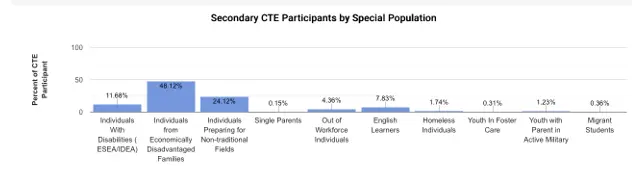 |
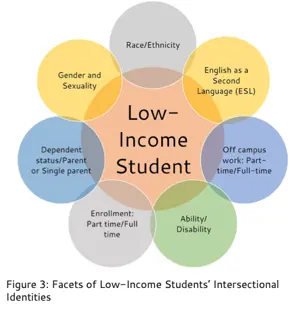
This special population is one of the largest among other special learner populations under Perkins V (Table 1). In 2021-2022 there were 8,151,708 secondary CTE participants nationwide. Despite the biggest share of this population of students, this population also is challenged by intersecting identities (Figure 3). Although not all learners from economically disadvantaged families share the same characteristics in demography, Graham and McCambly (2015) discussed about eight characteristics that are common in low-income student populations. Authors suggest that instead of one type of program for all, colleges should focus on students’ specific needs depending on their campus demographics (Graham & McCambly, 2015).
Advance CTE (n.d.) explored several strategies that can be used to support learners in the program, including focus on economic mobility which offers collective efforts creating opportunities for a family-sustaining wage. Because low-income students are part of a larger family in need, supporting an individual goes beyond helping just one person; it also includes raising awareness among extended family members.
References
Advance CTE (n.d.). Maximizing Access & Success for Special Populations. Retrieved from https://careertech.org/wp-content/uploads/2024/02/Supporting_Economically_Disadvantaged_Learners_CTE.pdf
Graham, E. and McCambly, H. (2015). Digging Deeper: Low-Income Students’ Intersecting Identities. Office of Community College Research and Leadership. Retrieved from https://occrl.illinois.edu/docs/librariesprovider2/ptr/insights-on-equity-and-outcomes-12.pdf?sfvrsn=4b30bf89_0
ICSPS (2025). The Illinois Center for Specialized Professional Support. Retrieved from https://icsps.illinoisstate.edu/accessible-practices/special-pops
Perkins Collaborative Resource Network (2025). The Office of Career, Technical and Adult Education. Retrieved from https://cte.ed.gov/pcrn/profile/national/enrollment/2022/participant/secondary/gender/allstudents