-
Who We Are -
What We Do -
Current Projects - Comprehensive Local Needs Assessment
- ICCB Developmental Education Reform
- Pipeline for the Advancement of the Healthcare Workforce (PATH)
- Portraits of Community College Student-Leaders: Emerging Visions for the Future
- Program Review Illinois
- SUCCESS: Supporting Universities and Colleges Creating Equitable Student Success
-
Our Products -
Contact Us
Portraits of Community College Student-Leaders:
Emerging Visions for the Future
Summary
This study explores the lived experiences of community college student leaders in Illinois through the lens of autoethnography, a qualitative research method that allows participants to reflect on their personal journeys by connecting their individual stories to broader cultural, social, and institutional contexts. Centering the voices of student leaders provides a platform for them to share their stories in their own words, as they explore how these identities intersect and influence their experiences, decision-making processes, and sense of belonging within the college community. While students uncover how these institutional dynamics shape their responsibilities and agency to effect change, the process may also allow them to become empowered to foster personal growth and gain a deeper understanding of their roles as leaders and advocates.
Background
Despite the wealth of insights on the demographics of community colleges, significant gaps remain in the literature regarding student leadership development in community colleges when compared to four-year institutions. Few studies explore the long-term impact of leadership experiences on community college students’ academic and career trajectories. Additionally, there is limited research on how institutional structures influence the availability and effectiveness of leadership opportunities. The voices of student leaders themselves are often absent from the discourse, highlighting the need for more qualitative, student-centered research. By addressing existing gaps in the current literature, this study and future research can provide valuable insights into how community colleges can better support and empower their student leaders, ultimately enhancing individuals and institutional outcomes.
Voices & Viewpoints
Me-Search: How Student Leadership Shaped My Higher Education
The education journey of OCCRL research assistant Gabrielle Haggins didn’t end with graduation; it evolved into pursuing higher education further. Read her Voices & Viewpoints blog post to discover how diving into student leadership as a first-generation college student changed her life.
“From the glass windows where you could see the entire campus to the formal agendas, none of it was familiar territory for someone who had never navigated higher education before. But that's exactly why I needed to be there.”
Read "Me-Search: How Student Leadership Shaped My Higher Education."
Democracy's College Podcast: Student Leadership in Community Colleges
With guests Leonidas Hamza and Deana Schenk and host Nina Owolabi
This Democracy's College episode explores the power, complexity, and impact of student leadership in Illinois community colleges, with insights from student leader Leonidas Hamza as well as from Deana Schenk, the senior director for student success at the Illinois Community College Board.
Read the Voices & Viewpoints blog post on this podcast and topic.
Modules
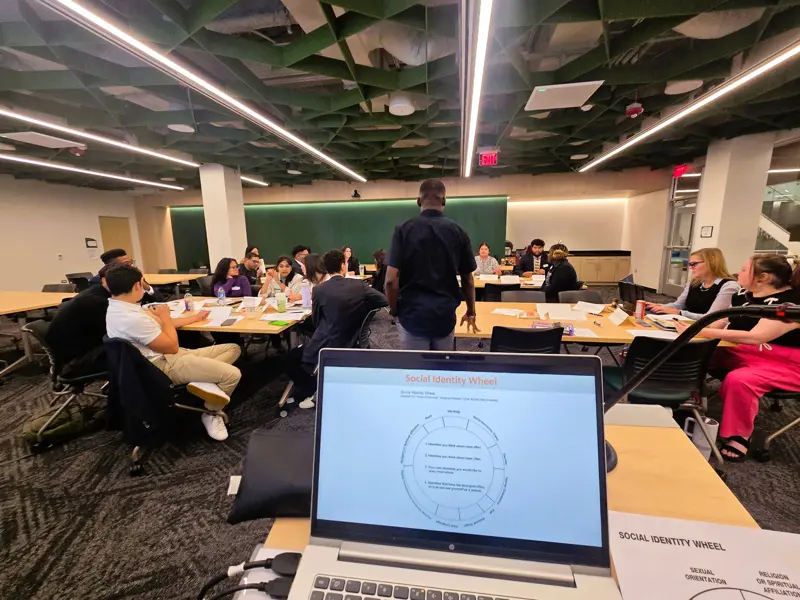
This me-search session from OCCRL introduces the "Portraits of Community College Student-Leaders" project. Highlights include a social identity wheel activity, a rundown of what me-search entails, and information on a survey completion.
We-Search: From Student Leader to Community Co-Researcher
This presentation with Gabrielle Haggins introduces community college student leaders to the concept of "we-search," a framework that encourages them to move beyond their individual experiences and think collectively about the needs of the students they represent on campus.
Module 3: Research - Academic Analysis and Broader Implications
This module with Nina Owolabi will help viewers integrate personal narratives with academic sources and analysis, develop skills for making arguments from personal experience, and understand how autoethnography contributes to scholarly conversations.